

TOO REAL TO WATCH
Mum and I have a similar sense of humour, interest in true crime documentaries and love to watch horror films together… there are SOME however that she won’t touch. The Green Mile is one of them. If violence or death in fiction feels TOO real then she can’t even HEAR about it, let alone watch it. In this case, the execution of a death row inmate.
I would say where Mum and I differ is that I can watch things like this happen. I know Mum understands it’s fiction, but knowing that doesn’t make it easier for her to watch. It IS upsetting to me too but I watch with an appreciation and respect for people who’ve actually gone through these situations.
Something that DOES cross a line for me is anything to do with animal cruelty, I imagine that’s something that Mum feels when she watches these scenes. I find it really difficult to watch something happen to an animal with no understanding of why or what is happening to them, this is one of the reasons I am vegan.
I wouldn’t casually ask Gran about the war. Gramp was away serving in the RAF and lost many friends and colleagues. For her, that history is personal, tied to someone she loved and people who never came home. I can choose to watch Saving Private Ryan or read a Holocaust survivor’s account, then put it down afterwards. That’s a different relationship with history from having it woven into your own life and family. My interest doesn’t mean someone else owes me their memories.
I think my boundaries have changed over time, I’ve noticed things become easier for me to watch with familiarity.
Playing as Michael Myers in Halloween the video game got me thinking, how had I gone from running out of the room at Beast’s scream in Disney’s Beauty and the Beast to controlling a horror-film killer myself? Was it simply growing up, familiarity or something about how I experience fictional violence? And beyond my own experience, was our appetite for gore actually growing or had we always wanted to look?
HAVE WE ALWAYS WANTED TO LOOK?
Discovering that people watched staged mutilation at the Grand Guignol, a Paris theatre in 1897, is quite a surprise to me though it probably shouldn’t be when you read some of Shakespeare’s plays! A pound of flesh… I don’t think I’d have managed to sit through that, personally,. Even if ACTED out in front of me it would still feel too real.
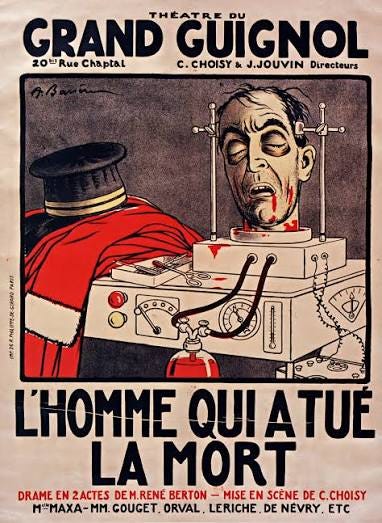
Charles Nonon, the Grand Guignol’s last director, argued that the boundary between reality and dark imagination has definitely blurred as modern warfare atrocities often match or EXCEED that of the horrors depicted in speculative fiction.
It leaves me wondering whether our appetite for violent entertainment has grown or whether we simply have more ways to encounter it and talk about it. The existence of the Grand Guignol complicates the idea that wanting to watch something gruesome is new. Real atrocities, too, long predate social media. That doesn’t tell me whether the world is becoming more violent but it makes me question how much of what feels new is about visibility. Are we witnessing more, or being shown more of what we once could have AVOIDED seeing?
ANOTHER DAY, ANOTHER HORROR
REAL violence appears everywhere today, from the news to a casual social media scroll between completely different videos. It appears without me CHOOSING to see it.
Scrolling on social media platforms, sometimes my feed feels full of videos from members of the public having witnessed something terrible and getting their camera phone out to capture it. I always wonder what I’d do in these situations but I think filming it would be the furthest thing from my mind. Recording CAN document events or preserve evidence; my concern is particularly about how someone’s suffering is circulated and consumed.
It feels awful to think that I can scroll past the end of someone’s life without even realising it, that their final moments have become nothing more than pixels to feed into an algorithm, pushed to unsuspecting people like myself.
REAL footage affects me in a different way. I immediately recognise that was a person going through something terrible and it WAS NOT staged. Even if a film is much more graphic, I don’t think you can ever shake the feeling of knowing that someone endured whatever it was you saw and THAT is scary.
I think repeated exposure to things like this might do several things; make you feel less shocked when you see it, more distressed or more inclined not to go scrolling on these apps again.
After seeing these real-life experiences, horror afterwards can feel like a controlled escape, where I KNOW the suffering I’m watching is STAGED.
HOW MUCH FURTHER CAN WE GO?
Watching the Saw films, I’m drawn to the idea of justice presented through the killer’s twisted logic. There’s something compelling about the supposed bargain: confront something about yourself and endure a terrible sacrifice for a chance to survive. It feels like a gruesome form of poetic justice, even as I question who gets to decide that someone deserves the punishment.
Is that part of the appeal for me - the story giving the violence a purpose I can follow, however disturbing? I surely didn’t have any qualms with John Wick taking several lives to seek vengeance for his dog!
Hostel feels entirely different to me because it’s not about any “just cause”. The violence feels deliberately gratuitous, yet somehow I still enjoy watching it. I think the building of suspense, the characters’ attempts to escape, knowing the killer is never far away, the atmosphere… these definitely play a part too. There are some parts of gore that feel very rea1 however and the split ankle scene in this film is one of them. I always cringe and feel very funny in my legs when that happens! I wonder why that specifically?
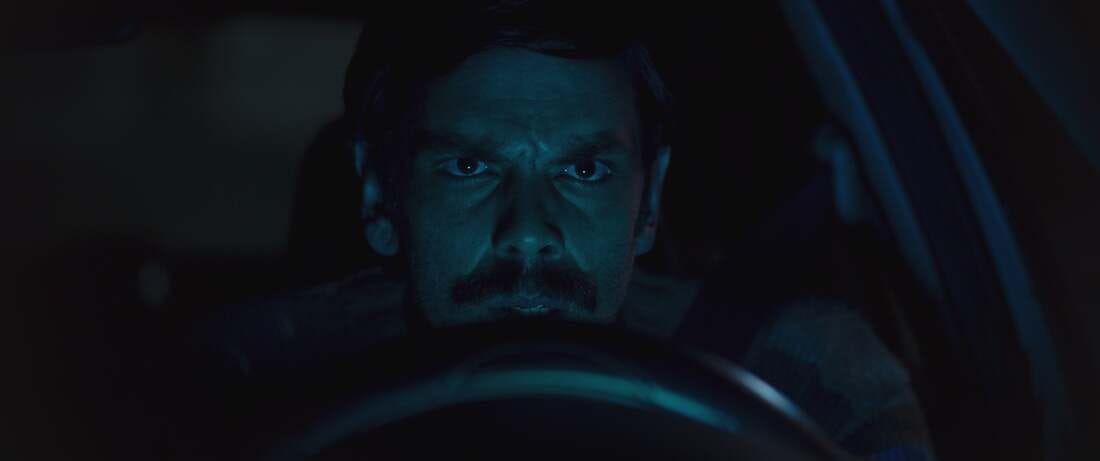
When I watched When Evil Lurks, it felt more extreme to me because nothing was off limits. I won’t go into the “gory” details but no one was safe. It stayed with me because, with the dog scene, I could imagine what was going to happen… and then it did… I couldn’t believe they’d gone there! There were also parts that I wouldn’t have imagined being in a film… it worked with the story but it felt new and it was shocking to me.
I think motive and story play a lot into what works well for me. Saw wouldn’t be the same I don’t think if there wasn’t that psychological element behind it. I don’t think I’d be as much of a fan if it were just the traps with no explanation as to why. Violence for violence’s sake is not something that entices me.
When I finish one of these films and feel sufficiently shocked and as though my brain has had a good workout, I look for similar films. It’s not about things being “more graphic” for me. I think the story attached to these scenes is what attracts me and affects me differently.
WHEN FEAR BECOMES DESIRE
I keep seeing reels and fan fiction discussing being “chased through the woods”. I keep coming across novels that feature that specific trope of being stalked and hunted through woods by some dangerous antihero.
People seem to be a lot more open about their preferences these days in the dark romance discussions I see online. I have a friend who reads a LOT and is very candid about it! It seems to be the pursuit, danger, mystery (often enhanced by a masked figure!) and I’d imagine, being so desperately wanted that they’d kill to have you!
I imagine part of the appeal is the pursuit, a loss of control, while still deciding when to close the book. That feels like an important distinction to me. A fantasy about being pursued doesn’t automatically mean wanting to be stalked or harmed in reality. If someone chooses to explore that fantasy with another person, consent, agreed boundaries and the ability to stop MATTER.
My response changes when the person being romanticised is a real killer. There are actual victims behind that story and I struggle with anything that makes the perpetrator desirable while pushing the people they harmed out of view.
THE KILLER GETS THE SPOTLIGHT
I have watched a lot of dramas based on serial killers and some of my favourites are by Ryan Murphy in his Monster series: The Jeffrey Dahmer Story, The Ed Gein Story.
What interests me in these dramas is the attempt to explore how these crimes happened and how other people were affected. I don’t watch them because I admire the killers but my own repsponse doesn’t settle the question of whether a portrayal glamorises someone. What I take as disturbing, another viewer might turn into a romantic fan edit. That gap between what a programme presents and what an audience takes from it is what troubles me.
I wonder how much “attractive casting” shapes those reactions, could “pretty privilege” cause people to unconsciously sympathise with the character ? Social media influence with its meme culture and fan edits can turn killers into heartthrobs, blurring the line between reality and fiction; where does admiration for a performance end and romanticising the real person being portrayed begin?
From Marc Jacobs saying he would dress Luigi Mangione who admitted to killing UnitedHealthcare CEO Brian Thompson in New York City. The August 2013 issue of Rolling Stone sparked widespread public outrage and boycotts by featuring Boston Marathon bombing suspect Dzhokhar Tsarnaev on its cover. These examples make me question how easily coverage of violence can take on the language and imagery of celebrity.
Mum and I enjoy watching true crime documentaries because of the justice involved or seeing the tireless efforts of those who look for the truth in cases that remain unsolved. It’s about highlighting real life stories so that victims and families aren’t forgotten and often get their chance to talk about how it has affected them. Seeing the perpetrators face justice is also a good way to put it away neatly in our brains after watching.
It’s the victim for me that remains in my mind after watching, sometimes wondering WHY the killer did what they did, but there isn’t always a clear explanation available to us. I think when brutality illustrates the effect it has had on their victims without glorifying it, it can help show us, as people who haven’t experienced a situation, some of the gravity of it.
WEARING OUR NIGHTMARES
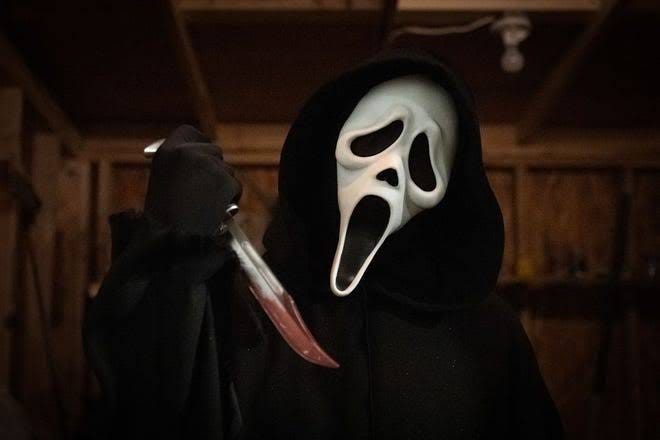
I own several horror-film T-shirts, some of them featuring Scream. There’s something I ADORE about Wes Craven and his mocking of typical slasher films and the “rules” they all follow. I love the references and nods to previous films, including John Carpenter’s Halloween.
It feels good to share that love with other fans, maybe at conventions or even just walking into my tattooist’s studio! He spends half of his life recreating these characters on our skin!
For me, wearing Ghostface or Michael Myers merchandise celebrates the craft and the films. NOT a real-life killer who has committed atrocities.
Music ADDS to that enjoyment. Ice Nine Kills are famous for their horror film tunes and “Play Dead”, their song for the game Dead by Daylight, is one of my favourites. The way the sound builds makes me feel as though I’m fleeing a killer or doing the chasing.
When a frightening killer becomes a familiar mascot, it changes what I’m waiting for. I recognise the mask, I know the conventions and part of the enjoyment is anticipating what comes next. But if familiarity becomes part of the appeal, does horror always need to go further? Or can returning to something we know be enough?
WHAT HAPPENS WHEN MORE STOPS WORKING?
When I started writing this I wondered whether we needed increasingly extreme violence in our fiction to satisfy our hunger. I’ve realised that, for me, the appeal depends on how it makes me feel, the story and characters around it. The chase, the anticipation, the escape from the everyday, something far from the norm that we can safely turn off after and resume our own lives.
I think being surprised by a film is different to pure shock at how far it can go with gore. The reason I respond so well to some of those titles mentioned in my piece is that they were not where I thought the film would go and they took directions I didn’t expect. That’s what feeds my horror fantasy, the wish to be surprised, I think, even in unsavory situations, the ability to let my brain off its metaphorical lead for a little.
I wonder whether there’s a point where overt cruelty stops offering us anything surprising. I think of people rediscovering vinyl: could horror audiences also find something rewarding in revisiting older approaches? Perhaps suggestion, atmosphere and sound could give us something we aren’t getting from another explicit image. What might a film make us imagine if it left more unseen?
I can enjoy extreme fictional horror, find comfort in familiar characters and still be deeply affected by real suffering. Those things can exist together. What I’m looking for next is something that surprises me and gives me a reason to keep thinking after the screen goes dark.
PLAYER TWO: Does horror need to go further to frighten you, or is it what a story makes you FEEL that stays with you? What film, game or book still gets under your skin and why?